PawPortrait Journal
The Rise of Pet Humanization: Dogs & Cats | PawPortrait
Aug 31, 2026
“Explore the fascinating psychology behind pet humanization and why we turn dogs and cats into characters. Discover how AI art and roasts bring pet alter-egos to life.”
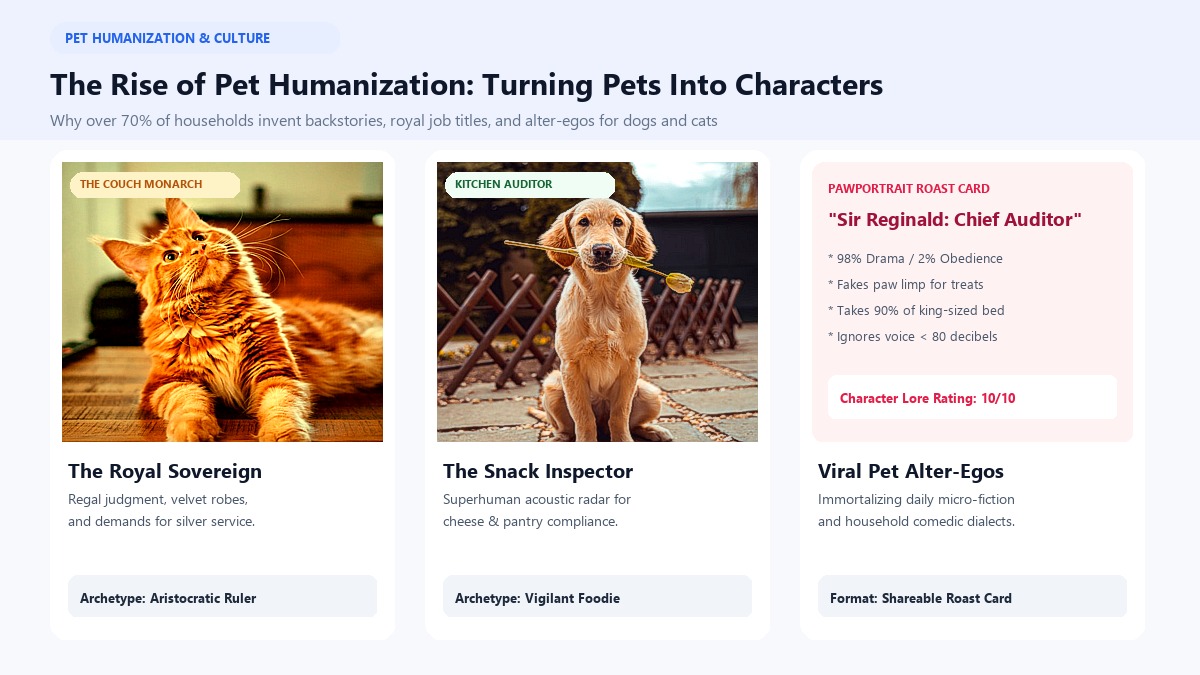
Pet humanization is the powerful cultural and psychological phenomenon where companion animals are embraced as full family members and endowed with distinct narrative personalities, internal monologues, and comedic alter-egos rather than viewed merely as working animals or property. Today, over 70% of households consider their pets to be their children, sparking a global creative movement where owners actively invent backstories, assign royal job titles, and celebrate the unrepeatable quirks of their dogs and cats.
If you have ever caught yourself speaking in a high-pitched aristocratic accent on behalf of your cat or explaining to dinner guests that your golden retriever is a "licensed snack auditor," you are participating in one of the most delightful cultural shifts of the 21st century. We no longer just care for our pets; we co-author their identities. Every sigh from the rug becomes a dramatic critique of the household management, and every twitch of a whisker is treated as a subtle expression of a complex personality.
Platforms like PawPortrait were built at the intersection of this emotional bond and playful storytelling, enabling pet parents to transform everyday photos into custom pet portraits and viral funny pet portraits & roasts in under 60 seconds.
In this deep dive, we explore the evolutionary neuroscience behind anthropomorphism, unpack the sociological forces transforming pets into household celebrities, breakdown the four universal pet character archetypes, and demonstrate how you can immortalize your pet's true alter-ego through modern AI art and personality cards.
Key Takeaways
- The Biological Drive: Pet humanization is powered by hardwired human neurochemistry, including the Kindchenschema (baby schema) and mutual oxytocin release that mirrors the biological parent-child bond.
- The Characterization Shift: Modern pet parents go beyond basic care to build rich "pet lore", inventing voice personas, dramatic backstories, and humorous job titles that serve as vital daily stress relief.
- The 4 Core Archetypes: Most companion animals naturally fall into recognizable personality archetypes, from the aloof Couch Monarch to the vigilant Certified Snack Inspector.
- Ethical Balance: Healthy pet humanization celebrates animal personality through affection, comedy, and keepsake art while strictly respecting species-specific physical, nutritional, and training needs.
- Instant Artistic Expression: Tools like PawPortrait allow pet owners to give visual form to their pet's alter-ego using curated fine-art styles and shareable AI personality roast cards without complex prompt engineering.
From Working Animals to Family Icons: The Cultural Evolution of the "Fur Baby"
For the majority of human history, companion animals held strictly utilitarian roles. Dogs guarded livestock, pulled sleds, and tracked game; cats patrolled grain silos and ships to eliminate rodents. While affection existed, the relationship was primarily transactional, governed by utility, outdoor living, and minimal emotional projection.
+-------------------------------------------------------------------------+
| The Historical Evolution of the Pet Role |
+-------------------------------------------------------------------------+
| 19th Century: Utilitarian Era (Barn cats, hunting hounds, yard guards) |
| 20th Century: Domestic Companion Era (Indoor living, basic commercial |
| kibble, nominal family pet status) |
| 21st Century: The Fur Baby & Character Era (Full emotional integration, |
| health insurance, custom art, viral personality lore) |
+-------------------------------------------------------------------------+
Over the past three decades, a profound demographic and sociological transition reshaped this dynamic. Several key cultural currents converged:
1. Urbanization and Changing Family Structures
As populations shifted into denser urban environments and the median age of marriage and first-time parenthood rose, dogs and cats transitioned from the backyard into the primary living room. According to research from the American Pet Products Association (APPA), more than seven in 10 pet-owning households now classify their animals as essential family members. For many young professionals and couples, pets serve as a meaningful foundation for caregiving routines and shared domestic responsibility.
2. The Search for Unconditional Connection
Modern digital life is characterized by hyper-connectivity paired with unprecedented rates of social isolation. In a world of complex workplace expectations and curated social media interactions, the relationship with a pet offers a rare sanctuary of pure, non-judgmental acceptance. A dog does not evaluate your quarterly performance reviews, and a cat does not care about your inbox backlog.
3. The Shift from Ownership to "Pet Parenting"
This emotional elevation fundamentally altered consumer behavior. Pet parents now invest in premium organic nutrition, orthopedic memory-foam bedding, behavioral therapy, and specialized keepsakes like custom dog portraits and custom cat portraits. Treating a pet well is no longer seen as an indulgence; it is viewed as a natural expression of familial love.
The Neuroscience of Anthropomorphism: Why Our Brains Can’t Help Humanizing Pets
The tendency to attribute human traits, emotions, and intentions to non-human beings is known scientifically as anthropomorphism. Far from being an irrational habit or mere silliness, anthropomorphism is an innate cognitive mechanism deeply embedded in human evolutionary biology.
 +-------------------------------------------------------------+
 | The Biological Drivers of Pet Humanization |
 +-------------------------------------------------------------+
 |
 +----------------------------+----------------------------+
 | |
 v v
+-----------------------------+ +-----------------------------+
| Kindchenschema Cues | | The Oxytocin Feedback |
| (Big eyes, round foreheads, | | (Mutual gaze triggers 300% |
| infant-like proportions) | | neurochemical spike) |
+-----------------------------+ +-----------------------------+
1. Kindchenschema (The Baby Schema)
First identified by ethologist Konrad Lorenz, Kindchenschema refers to a specific cluster of physical features, such as a large head relative to body size, a prominent rounded forehead, large low-set eyes, and soft curved contours.
When humans perceive these juvenile features, our neural pathways trigger immediate caregiving instincts and dopamine release. Selective breeding over thousands of years has accentuated these traits in domestic dogs and cats. In fact, evolutionary biologists have discovered that domestic dogs developed a specialized facial muscle, the levator anguli oculi medialis, specifically allowing them to raise their inner eyebrows to mimic human sadness and infant vulnerability.
2. The Mutual Oxytocin Loop
In a landmark neurobiological study published in the journal Science by Dr. Takefumi Kikusui and colleagues, researchers demonstrated that when owners and dogs engage in mutual eye contact, both species experience a significant surge in oxytocin, the exact neuropeptide responsible for maternal-infant bonding. This chemical feedback loop proves that the emotional intimacy we experience when locking eyes with our pets is biologically identical to human familial attachment.
<iframe width="560" height="315" src="https://www.youtube.com/embed/gBnmTszhE-g" title="The Science of the Human-Dog Bond" frameborder="0" allow="accelerometer; autoplay; clipboard-write; encrypted-media; gyroscope; picture-in-picture" allowfullscreen></iframe>3. Social Mirroring and Emotional Resonance
Dogs and cats are master observers of human body language and vocal inflections. Because they respond dynamically to our moods, curling up beside us when we are weeping or bouncing with excitement when we celebrate, our cognitive theory of mind naturally assumes an empathetic, human-like consciousness behind their actions.
Why We Turn Pets Into "Characters": The Psychology of Pet Lore & Voice Acting
While science explains why we love our animals, it does not fully explain why we give them elaborate fictional lives. Why do millions of households establish elaborate backstories, invent bespoke speaking voices, and narrate their pet's thoughts throughout the day?
+-------------------------------------------------------------------------+
| The 3 Psychological Functions of Pet Lore |
+-------------------------------------------------------------------------+
| 1. Domestic Micro-Fiction → Spontaneous humor and shared comedy |
| 2. Emotional Safe-Harbor → Venting human frustration through comedy |
| 3. Relationship Bonding → Building an exclusive couples' dialect |
+-------------------------------------------------------------------------+
The Power of Domestic Micro-Fiction
Creating a persona for a pet is an accessible, everyday form of collaborative storytelling. When a couple notices their French bulldog standing with a haughty, unblinking posture in the entryway, labeling him "Sir Barnaby, Senior Inspector of Imported Textiles" turns a routine moment into shared domestic theater.
Consider Marcus and Elena, who adopted an elderly Basset Hound named Winston. Winston was slow, stubbornly refused to walk in light rain, and possessed heavy jowls that gave him a perpetually grave expression. Rather than viewing these quirks as inconveniences, Marcus and Elena created a character: Winston was a retired, world-weary 19th-century appellate judge who believed the living room rug was a courtroom and that dinner delays constituted high treason. Speaking in a slow, gravelly baritone on Winston's behalf transformed daily chores into continuous comedic joy.
Emotional Venting Through a Furry Proxy
Psychologists note that speaking through a pet provides a gentle, disarming emotional buffer. If one partner forgets to take out the recycling, saying "Barnaby notes that your logistics management requires immediate administrative review" diffuses tension through laughter far more effectively than direct criticism. The pet becomes a safe emotional mediator, lightening the gravity of daily human stress.
Building Private Shared Realities
Sociolinguists have observed that couples and close families who develop idiosyncratic internal languages, including unique pet voices, exhibit higher relationship satisfaction. The shared lore creates an "in-group" intimacy that belongs exclusively to the household.
The 4 Universal Pet Character Archetypes
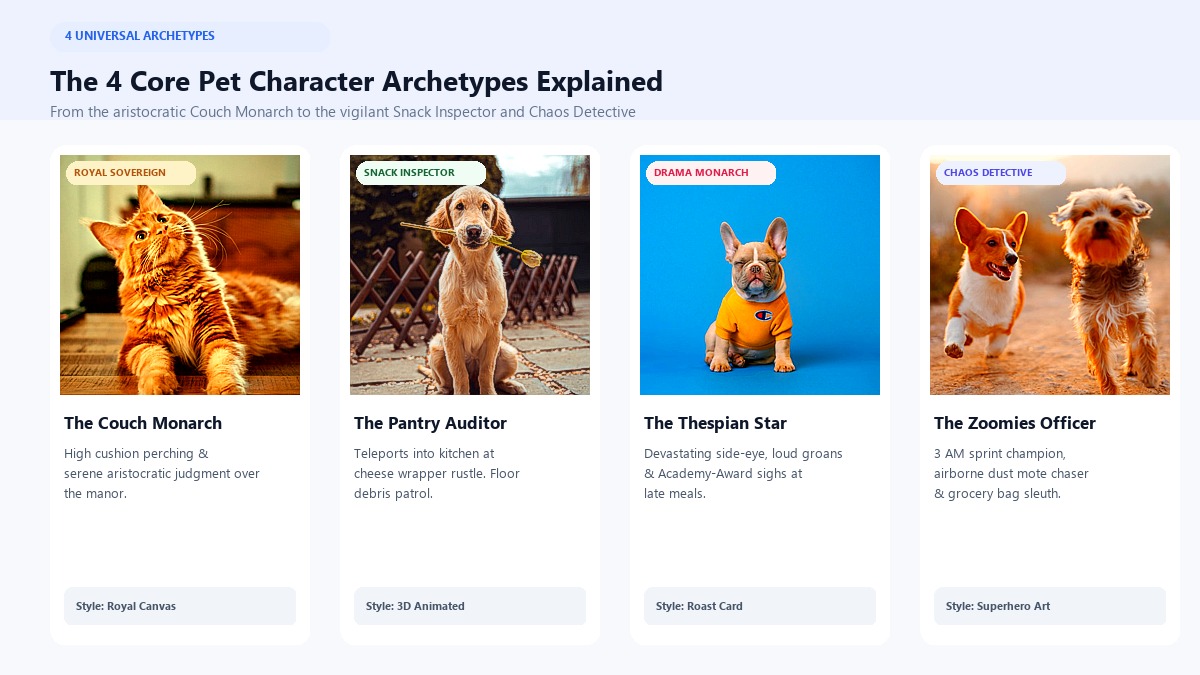
Through social media trends, viral pet communities, and thousands of generations analyzed on PawPortrait, distinct behavioral archetypes consistently emerge across dogs and cats:
+-------------------------------------------------------------------------+
| The 4 Universal Pet Character Archetypes |
+-------------------------------------------------------------------------+
| [ The Royal Sovereign ] | [ The Certified Snack Inspector ] |
| • Supreme entitlement | • 24/7 kitchen acoustic radar |
| • Expects silver platter service | • Teleports at cheese unwrapping |
| • Perfect for: Cats & Hounds | • Perfect for: Labs & Goldens |
|---------------------------------+---------------------------------------|
| [ The Drama Monarch ] | [ The Chaos Detective ] |
| • Academy-award worthy sighs | • 3 AM parkour champion |
| • Dramatic side-eye master | • Hyper-fixated on random dust motes |
| • Perfect for: Huskies & Pugs | • Perfect for: Kittens & Terriers |
+-------------------------------------------------------------------------+
1. The Royal Sovereign (The Couch Monarch)
- Signature Behavior: Sits on the highest possible cushion, looks down upon guests with serene aristocratic judgment, and expects meals served precisely on schedule.
- Internal Monologue: "I have permitted you to inhabit my palace, human. You may demonstrate your gratitude with freeze-dried salmon."
- Best Art Style Match: Royal Portrait featuring ornate velvet mantles, gold medallions, and 18th-century oil-canvas texture.
2. The Certified Snack Inspector
- Signature Behavior: Exhibits superhuman auditory acuity for the rustle of a string cheese wrapper from three rooms away. Sits directly in the "drop zone" beneath the kitchen cutting board.
- Internal Monologue: "Quality control check required. All floor debris must be cleared immediately for safety protocols."
- Best Art Style Match: 3D Cartoon with oversized luminous eyes and expressive comic lighting.
3. The Drama Monarch
- Signature Behavior: Emits theatrical groans when forced to walk in wet grass. Throws their head back and sighs loudly if dinner is two minutes late. Gives devastating side-eye glances from the corner of the sofa.
- Internal Monologue: "The hardships I endure in this household are truly unprecedented in the annals of history."
- Best Art Style Match: Personality Roast Card breaking down their signature behavioral grievances and drama scores.
4. The Chaos Detective (The Zoomies Officer)
- Signature Behavior: Explodes into spontaneous 3:00 AM living-room sprints, wages fierce battles against invisible airborne dust motes, and investigates grocery bags with extreme urgency.
- Internal Monologue: "Code Red! The living room perimeter has been compromised! Commencing tactical evasive maneuvers!"
- Best Art Style Match: Superhero Style equipped with aerodynamic armor and cinematic action backdrops.
The Archetype Comparison Matrix
| Archetype | Common Breeds | Signature Tell | Preferred Household Role | Ideal Keepsake Format |
|---|---|---|---|---|
| The Royal Sovereign | Persian, Siamese, Afghan Hound, Basset Hound | Unblinking aristocratic stare from high elevation | Lord / Lady of the Manor | 18th-Century Canvas Oil Print |
| The Snack Inspector | Golden Retriever, Beagle, Labrador, Corgi | Teleportation upon sound of refrigerator opening | Chief Pantry Compliance Officer | 3D Animated Studio Portrait |
| The Drama Monarch | French Bulldog, Husky, Pug, Sphynx | Heavy sighs and vocal theatrical complaints | Academy Award Lead in Tragedy | AI Personality Roast Card |
| The Chaos Detective | Jack Russell, Australian Shepherd, Bengal Cat | Instantaneous 90-degree drift turns on hardwood floors | Tactical Defense Commander | Superhero Comic Book Poster |
The Double-Edged Sword: Celebrating Character vs. Respecting Animal Instincts
While anthropomorphism fosters deep empathy and joyful creativity, veterinary behaviorists emphasize that pet parents must maintain a healthy boundary between affectionate storytelling and realistic animal welfare.
+-------------------------------------------------------------------------+
| Healthy Love vs. Harmful Anthropomorphism |
+-------------------------------------------------------------------------+
| ✅ HEALTHY: Inventing funny backstories & voices for household laughs |
| ✅ HEALTHY: Commissioning custom art & sharing personality cards |
| ✅ HEALTHY: Giving deep affection while maintaining structured training |
|-------------------------------------------------------------------------|
| ❌ HARMFUL: Attributing moral "spite" or "revenge" to stress behaviors |
| ❌ HARMFUL: Overfeeding human treats as a substitute for exercise |
| ❌ HARMFUL: Forcing animals into restrictive costumes that induce panic |
+-------------------------------------------------------------------------+
The Myth of the "Guilty Dog"
One of the most common misinterpretations of animal behavior is the famous "guilty look." When an owner returns home to find a chewed shoe and sees their dog cowering with pinned-back ears and lowered eyes, the owner often assumes the dog feels remorse for their disobedience.
Scientific studies pioneered by Dr. Alexandra Horowitz have demonstrated that dogs display this submissive body posture exclusively in response to the human's tense facial cues and vocal tone, regardless of whether the dog actually chewed the object. Attributing human moral reasoning like "spite" or "malice" to an animal leads to ineffective punishment and heightened anxiety.
Guidelines for Responsible Characterization
- Never Punish Based on Projected Intent: Destructive chewing or litter box avoidance are symptoms of anxiety, boredom, or medical discomfort, never personal vendettas.
- Respect Physical Comfort: Celebrate your pet's regal persona through digital portraiture rather than forcing them into heavy, uncomfortable physical outfits that restrict movement or trap heat.
- Honor Species-Specific Needs: Dogs need sniffing walks and structured mental puzzles; cats need vertical territory and scratching posts. Celebrate who they are as dogs and cats first.
The Modern Expression: How AI Turns Pet Personalities Into Fine Art & Roast Cards
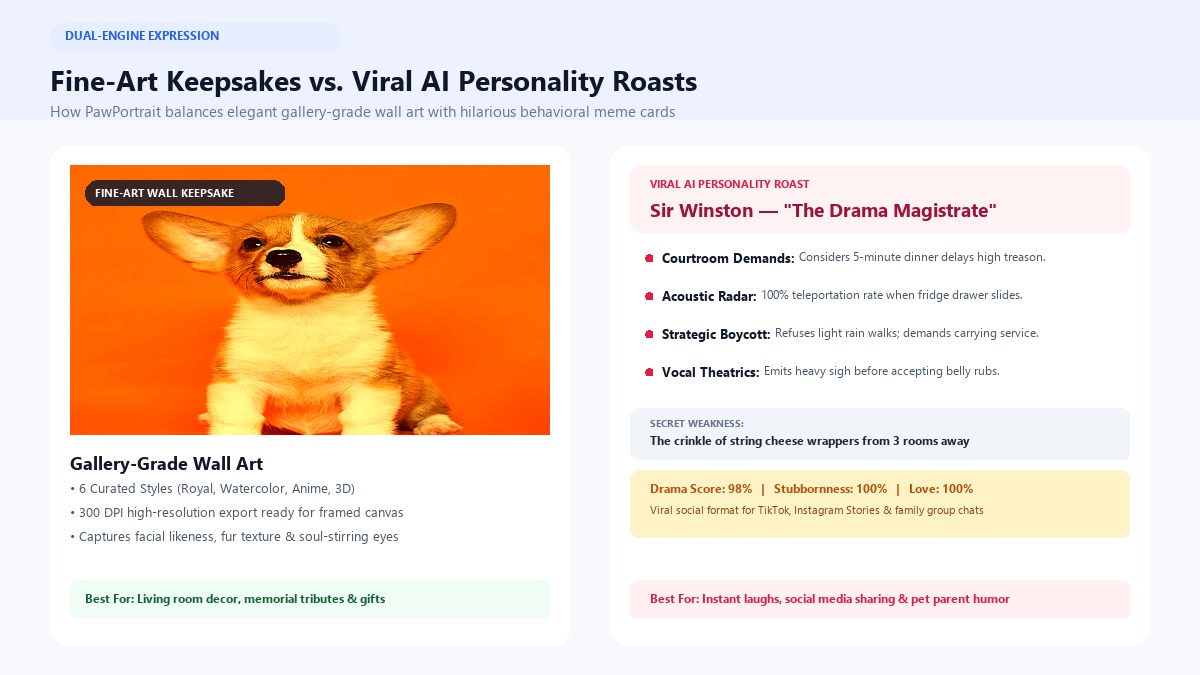
In earlier eras, immortalizing a pet’s character required either weeks of amateur sketching or spending hundreds of dollars commissioning a traditional human painter. Today, purpose-built creative platforms have democratized pet portraiture, allowing anyone to turn a single smartphone picture into gallery-grade art or viral social cards.
 +-------------------------------------------------------------+
 | The Modern Dual-Engine Pet Keepsake |
 +-------------------------------------------------------------+
 |
 +----------------------------+----------------------------+
 | |
 v v
+-----------------------------+ +-----------------------------+
| Fine Art Wall Keepsakes | | Viral AI Personality Roasts|
| (Royal, Watercolor, Cozy | | (Archetype titles, funny |
| Illustration for home art) | | flaws, social share cards) |
+-----------------------------+ +-----------------------------+
1. Fine-Art Visual Alter-Egos
With specialized engines trained on canine and feline facial anatomy, platforms like PawPortrait accurately preserve your pet's distinctive markings, eye colors, and ear expressions across a variety of curated aesthetics:
- Watercolor Pet Portraits: Soft, delicate brushwork and pastel bleeds that capture gentle, soulful temperaments.
- Royal & Renaissance: Regal velvet capes, golden crowns, and moody oil textures that elevate your couch sovereign into an 18th-century monarch.
- 3D Cartoon & Superhero: Bold, vibrant characters that showcase energetic zoomies and heroic antics.
2. Viral AI Personality Roast Cards
Beyond classic wall art, modern pet parents love celebrating their pet’s hilarious imperfections. By analyzing facial expressions, body language, and behavioral traits, PawPortrait's funny pet portraits & roasts engine generates a personalized character card complete with:
- A custom Archetype Title (e.g., "The Blanket Usurper")
- 3–4 hilariously accurate Behavioral Flaws (e.g., "94% chance of faking a paw limp for peanut butter")
- A designated Secret Weakness (e.g., "The squeak of a brand new tennis ball")
+---------------------------------------------------------------+
| PAWPORTRAIT ROAST CARD |
+---------------------------------------------------------------+
| Name: Sir Reginald |
| Title: Chief Snack Compliance Officer |
| Archetype: The Couch Monarch |
| |
| Behavioral Audit: |
| [x] Pretends not to hear commands under 80 decibels |
| [x] 100% teleportation rate when string cheese unwraps |
| [x] Demands 90% of the duvet while taking up 12% body weight |
| |
| Secret Weakness: The sound of the treat pantry latch |
| Personality Score: 98% Drama / 2% Obedience |
+---------------------------------------------------------------+
How to Capture Your Pet's True Character in 3 Simple Steps
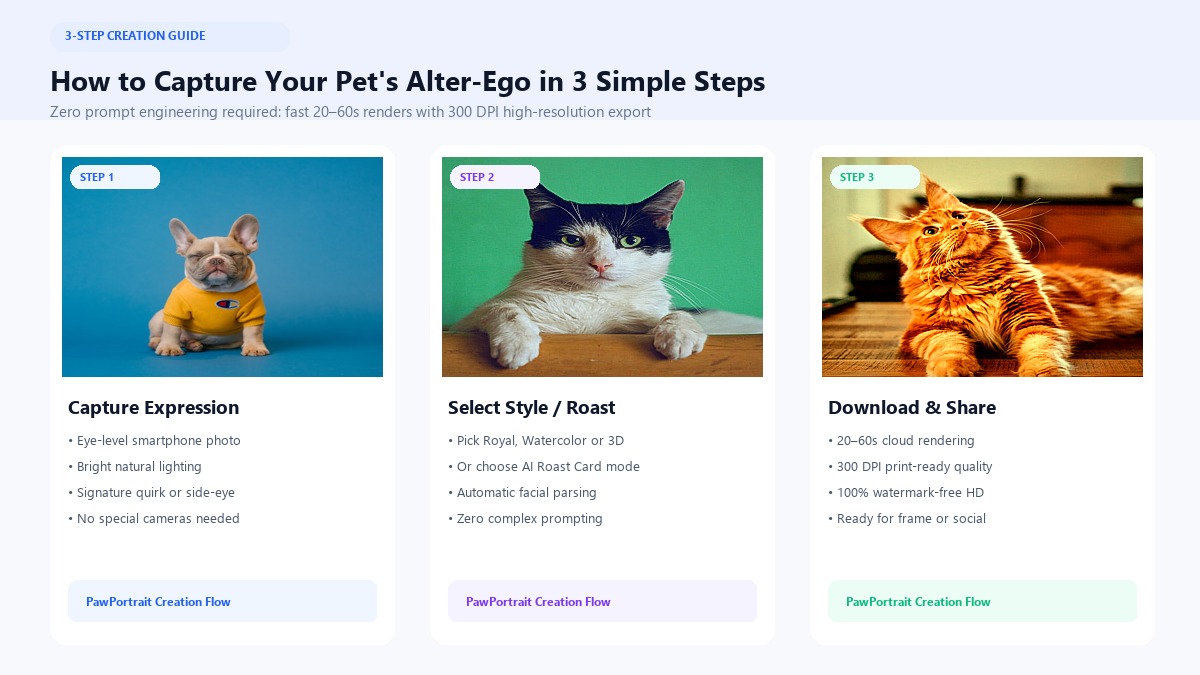
Creating a high-resolution, watermark-free tribute to your pet's alter-ego requires zero prompt engineering or artistic background:
+-------------------------------------------------------------------------+
| Step-by-Step Character Creation Guide |
+-------------------------------------------------------------------------+
| Step 1: Snap a clear, eye-level photo in natural light |
| Step 2: Upload to PawPortrait & choose your style or roast mode |
| Step 3: Download 300 DPI high-res art in 20–60 seconds |
+-------------------------------------------------------------------------+
- Capture the Expression: Snap an eye-level photo in bright, natural light where your pet is displaying their signature expression, whether it’s a mischievous smirk, a soulful gaze, or aristocratic side-eye.
- Select Your Style or Roast: Visit the PawPortrait Creation Studio and select your preferred artistic direction (Royal, Watercolor, 3D Cartoon, Superhero, Minimal Studio) or opt for the instant Personality Roast.
- Download & Share: In just 20 to 60 seconds, your artwork is rendered at 300 DPI print-ready quality. Print it on framed canvas, set it as your phone wallpaper, or drop the roast card into your family group chat for instant laughs.
With transparent pay-as-you-go credit packs starting at just $4.99 (and no recurring subscription traps), you can experiment with multiple styles and archetypes whenever your pet invents a new quirk.
Frequently Asked Questions
What is pet humanization in psychology?
Pet humanization is the psychological process where pet owners attribute human emotions, social roles, and familial status to companion animals. Rooted in evolutionary caregiving mechanisms like Kindchenschema and mutual oxytocin bonding, it fosters deep empathy and transforms pets from simple animals into beloved family characters.
Is it normal to give your pet a specific voice and personality?
Yes, giving your pet an invented voice and character backstory is an extremely common, healthy form of domestic storytelling. It provides daily stress relief, strengthens emotional bonds within couples and families, and turns ordinary pet quirks into shared laughter and affection.
Can pet humanization be harmful to dogs and cats?
Pet humanization is harmful only when owners project complex human moral emotions like "spite" or "revenge" onto natural animal stress behaviors, or when they substitute human food for proper exercise and veterinary care. Celebrating pet personality through affection, humor, and artwork while respecting their biological needs is entirely positive.
Why do pet parents love putting pets in Royal and Renaissance portraits?
Royal pet portraits resonate because they visually formalize the playful dynamic already present in the home: cats and dogs that rule the household, demand room service, and gaze at their owners with effortless, unbothered majesty. The visual contrast between historic aristocracy and furry faces creates timeless comedic charm.
How does PawPortrait turn a pet photo into a personality roast or portrait?
PawPortrait uses specialized neural art models trained specifically on dog and cat facial features. By analyzing a single photo, the engine maps fur texture, lighting, and expressions into six curated fine-art styles or generates a custom, viral personality roast card in 20–60 seconds with zero manual prompting needed.
Conclusion: Celebrate the Unrepeatable Character Behind the Fur
The rise of pet humanization is ultimately a testament to our capacity for joy, empathy, and unconditional love. Our dogs and cats may not understand stock market fluctuations, mortgage rates, or career ambitions, but they enrich our lives by anchoring us in the present moment with their boundless curiosity, comedic stubbornness, and fierce devotion.
Whether your pet is an aloof couch monarch who commands the living room or a chaotic treat detective who investigates every grocery bag, their quirky personality deserves to be celebrated.
Start creating with PawPortrait today, upload a photo of your beloved dog or cat, explore our curated fine-art styles, and discover your pet’s secret alter-ego in under 60 seconds.